

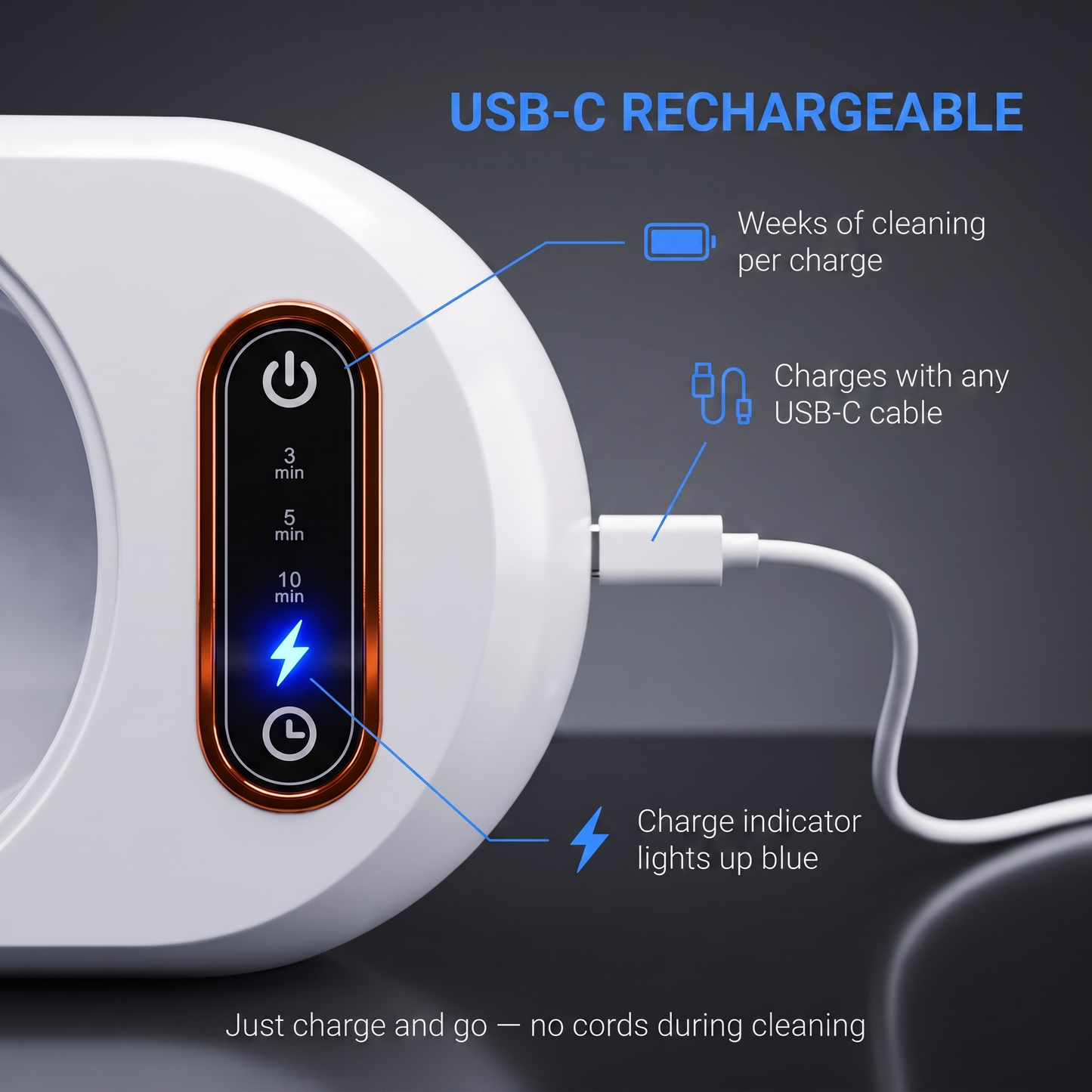
Charged it once when it arrived and it's lasted weeks of daily use. USB-C so I charge it with the same cable as my phone.


The deep clean your cloth can't do. Drop your glasses in, press one button, and lift years of oil, makeup and grime off the whole pair — in 3 minutes,without ever touching the lens.
Couldn't load pickup availability
Ships FromTexas
30-Day Risk-Free Trial
Order will arrive by Thursday, September 3rd
Why People Choose ClearWave
Cleans what your cloth can't reach
Gentle on every lens — zero scratching
Hands-free clean in 3 minutes
Works with every pair you own.
Prescription, reading, blue-light, sunglasses and polarised — all compatible.
Coated, high-index, anti-reflective and progressive lenses — no exceptions.
Every frame material: acetate, metal, plastic and combination.
It even reaches the nose pads, hinges and frame seam a cloth never can. Just place your glasses in and press the button.
The DoctorOptix ClearWave is built for daily use
and reliability.
It's made to be simple, effective, and built to last.
The ultrasonic waves are generated inside the water.
You can use it for:
It's always working, so you don't have to.
Shipping
All orders are shipped from our warehouse in the United States.
1-Year Warranty
If your DoctorOptix ClearWave ever stops working — for any reason, at any time — we will send you a free replacement. No questions asked. Forever.
30-Day Risk-Free Trial
Try it for 30 days, and if you don't like it for any reason at all, send it back. No questions asked.




Fill the tank with tap water to the fill line. For makeup, sunscreen or heavy buildup, add one small drop of mild dish soap.

Place your glasses in so the lenses are fully under water, press the button, and select your cycle — 3, 5 or 10 minutes.

Lift your glasses out and pat them dry with the included microfiber cloth — just drying clean, wet lenses, never rubbing dirt across them. Crystal-clear vision, every time.
Slide to compare lenses before and after DoctorOptix ClearWave cleaning.


 DoctorOptix ClearWave
 Cloth & Wiping
DoctorOptix ClearWave
Cloth & Wiping
Cloth & Wiping
DoctorOptix ClearWave
Cloth & Wiping

Find answers to common questions about our products and services.
No — it's the gentlest way to clean glasses there is. Nothing physically touches your lenses: the cleaning happens through water, not friction. Coated, anti-reflective, blue-light and high-index lenses are all safe. The real damage comes from wiping dry lenses with a cloth or shirt, which acts like fine sandpaper. This is the opposite of that. If your lenses are old with already-peeling coatings, check with your optician first.
It works — and you'll see it the first time. After one cycle the water turns cloudy and grey with the oil, makeup and dead skin lifted off your glasses. It's the same ultrasonic technology opticians, jewellers and labs have used professionally for decades, shrunk down for your bathroom counter.
Because a cloth only cleans the flat front of the lens — and smears the oil around while slowly scratching it. It can't reach the nose pads, hinges or the seam where the lens meets the frame, which is exactly where buildup hides. This cleans the whole pair at once, including the parts your cloth never touches.
Yes. The tank holds full-size frames and sunglasses with room to spare — prescription glasses, readers, blue-light and polarised pairs all fit. Simply lay them in so the lenses are fully under the water and press the button.
The ClearWave is USB-C rechargeable and runs for weeks of daily use on a single charge. Recharge anytime with the included cable. If it ever seems unresponsive, it most likely just needs a charge — plug it in for 1–2 hours before first use.
Overall rating: 4.8 / 5 from 135 reviews.
Charged it once when it arrived and it's lasted weeks of daily use. USB-C so I charge it with the same cable as my phone.

My vision is sharper just because my lenses are actually clean now. Didn't realize how much grime I was looking through.

You don't realize how dirty your glasses are until you see the water turn murky in three minutes. It's weirdly satisfying and gross at the same time. Hooked.

This has quietly become one of my favorite daily habits. Clean glasses every single morning with no effort. Wouldn't go back.

As someone with pricey high-index lenses, the no-contact cleaning is the whole point for me. Clean lenses with zero risk to the coating.

It's idiot-proof. Water, glasses, button. Even my husband who breaks everything manages it fine.

Used it on my sunglasses and they came out crystal clear. The polarized coating is fine, and all the sunscreen smears are gone.
Works well!
The cleaner works beautifully. It’s so much better than the other brand I had before.i highly recommend your product.
Works great, my glasses have never been so clean!
Genuinely wish I'd found this sooner. The amount of time I wasted wiping and re-wiping and never getting them clear. Three minutes and done.
Honestly the best part is how little I have to do. Fill, drop, press, walk away. Three minutes later, perfect glasses.
Didn't realize how much film built up on my glasses from a full workday until I started cleaning them properly. Huge difference on screen clarity.
I like the three timer options. Three minutes for a daily clean, ten for when they're really bad. Simple and it just works.
Dropped my glasses in expecting nothing and the water went grey within a minute. Honestly grossed me out in the best way. They've never been this clean.
At 70 my hands aren't steady and tiny cloths frustrate me. This does all the work for me. Best thing I've bought in ages.
Bought one for myself and immediately ordered two more as gifts. Everyone I know who wears glasses needs this.
My eyesight isn't great without my glasses so cleaning them was always a struggle. Now I just drop them in. So much easier.
Mascara flakes and face oil used to live on my lenses. The cloth just smeared them. This actually removes them properly.
Expected a cheap toy that buzzes and does nothing. Instead it actually cleans better than I ever could by hand. Color me converted.
Obsessed with this little thing. Clean glasses daily, zero effort.
Ran my expensive sunglasses through it expecting trouble and they came out perfect. No haze, no smears, no damage.
It cleans the parts of my glasses I never even thought about — the hinges, the little arms, the nose pads. All of it comes out fresh.
My whole family uses it. Kids' glasses, my readers, my wife's sunglasses. It handles everything and there's never any argument over it.
As a mechanic my glasses get filthy. Oil, dust, grime. This is the only thing that gets them back to clear.
Gave one to my mom for her birthday and she's obsessed. She runs her reading glasses every morning now and tells everyone about it.
I work at a screen all day and my blue-light glasses were always hazy by lunch. Running them each morning fixed that. Crisp all day now.
I noticed crusty buildup around the hinges and the part that sits on my nose. A cloth does nothing there. This cleared it completely.
Cleans my glasses better than anything else I've tried. Drops half a star because charging took longer than I expected the first time. Fine since then.
Small enough to keep on my bathroom counter and light enough to take when I travel. Cleans my glasses anywhere.
I cook professionally and grease ends up on everything including my glasses. This cuts right through it. Lifesaver.
My rimless glasses always worried me to clean by hand. This cleans them gently with no pressure on the lenses. Perfect.
We have four pairs of glasses between us at home and this cleans all of them. One device, whole household sorted.
I love that I just drop them in and walk away. By the time I've brushed my teeth they're done. Zero effort.
The before-and-after on the water alone sold me. Whatever was on my lenses is now in the tank instead of on my face. Can't unsee it.
I run them every morning now without thinking about it. Clean lenses have become my normal and I love it.
Good clean every time. The blue light is a bit bright in a dark bathroom but that's nitpicking. Does the job well.
My optician always told me to rinse them under water but it never did much. This is on another level. Lenses are flawless now.
Battery life is excellent. I expected to be charging it constantly but it goes weeks. Very low maintenance.
Cleanest my glasses have ever been. Simple as that.